
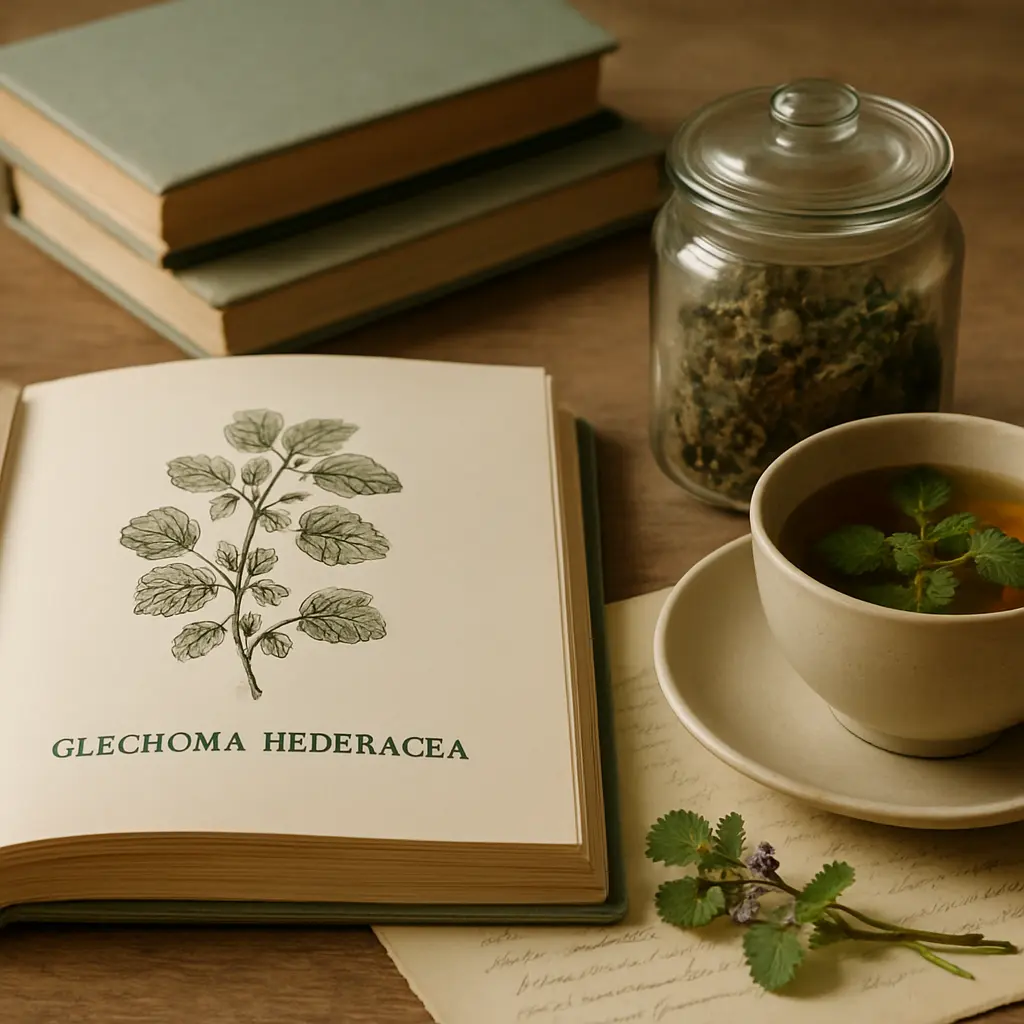
Exploring the Glechoma hederacea: A Journey into an Age-Old Herbal Remedy
In this page
Glechoma hederacea, often known as ground ivy, is a perennial plant cherished in traditional herbal medicine. Despite being labeled a weed by many, this plant is garnering interest due to its intriguing chemical composition and versatile uses. It thrives in temperate zones and holds potential for use in the food and herbal industries, although scientific research on its properties is still in its infancy. This article delves into its characteristics, properties, applications, and safety profile, providing a comprehensive overview of this fascinating plant.

Scientific Background and General Context
Glechoma hederacea, commonly referred to as ground ivy, belongs to the mint family, Lamiaceae, and is native to Europe and Asia, having also found a home in North America as an introduced species. This plant is recognized for its characteristic square stems and creeping growth habit. Despite its reputation as a pervasive garden weed, ground ivy has a rich history in traditional medicine and cooking, dating back centuries.From a botanical perspective, ground ivy is a hardy plant with a robust capacity to spread across its environment. Its invasiveness outside its native range speaks to its adaptability and resilience. The plant’s leaves are kidney-shaped with a scalloped edge, and it produces small, violet-blue flowers. This floral display, combined with the plant’s aromatic properties, makes it attractive not only to humans but also to pollinators like bees.

Natural Habitat and Distribution
Ground ivy is predominantly found in moist, shady environments such as meadows, roadside verges, and the edges of deciduous forests. Its presence spans across Europe, extending into Western and Northern Asia. As a testament to its ecological versatility, ground ivy has successfully naturalized in North America, where it is often found in similar habitats.The plant’s ability to propagate rapidly through its stolons makes it a formidable competitor in both natural and cultivated landscapes. This has led to its classification as an invasive species in regions where it is not native, posing challenges to biodiversity and land management.
Distinctive Properties of Glechoma hederacea
The aromatic profile of ground ivy is one of its most distinctive features, primarily due to the presence of volatile compounds such as essential oils. These oils impart a balsamic and herbaceous fragrance to the plant, with a taste that is bitter, slightly spicy, and cooling. The monoterpenes, such as menthone, are responsible for this cooling sensation, somewhat reminiscent of menthol.
Chemical Composition
Scientific analysis has unveiled a rich array of chemical constituents within ground ivy. Phenolic compounds like rosmarinic acid, p-coumaric acid, and caffeic acid are abundant, alongside flavonoids such as apigenin and luteolin. These compounds are renowned for their antioxidant properties, contributing to the plant’s potential health benefits.Additionally, the essential oil fraction, although present in small concentrations, includes compounds like 1,8-cineole, α-pinene, β-caryophyllene, and humulene. These components are noteworthy for their aromatic and potentially preservative qualities.
Essential Oil Characteristics
The essential oils extracted from ground ivy are not only aromatic but also exhibit notable solubility in water and ethanol, making them suitable for various herbal preparations such as infusions, decoctions, tinctures, and macerations. This versatility enhances the plant’s appeal both in traditional remedies and contemporary herbal applications.
Traditional and Modern Uses of Ground Ivy
Historically, ground ivy has been a staple in traditional European cuisines, particularly valued for its ability to enhance the flavor of rustic dishes. Its aromatic leaves were commonly used as a seasoning in soups, stuffings, cheese spreads, egg dishes, and flour-based creations like dumplings and pancakes.
A Culinary Herb with Historical Roots
In past centuries, ground ivy was employed similarly to herbs like parsley and cilantro, albeit with a more pronounced flavor profile. In certain German-speaking regions, it was used to flavor beer before hops became widespread, earning it the nickname “alehoof.” This historical application highlights the plant’s longstanding culinary significance.
A Resurgent Interest in Gastronomy
In recent years, culinary professionals and enthusiasts have rekindled interest in ground ivy, particularly within the realms of wild food foraging and fermentation. Its distinctive aroma makes it an intriguing alternative to conventional spices, and it is being explored in contemporary dishes such as pesto and root vegetable ferments. The vibrant colors of its flowers also enhance its appeal as a decorative element in modern cuisine.
Potential Health Benefits and Biological Activity
Numerous in vitro and in vivo studies have investigated the biological activities of ground ivy extracts. These investigations, although preliminary and primarily conducted in cell or animal models, suggest a range of potential health benefits.
Antioxidant and Anti-Inflammatory Properties
Ground ivy extracts have demonstrated potent antioxidant properties, which are largely attributed to phenolic compounds like rosmarinic acid and flavonoids such as apigenin and luteolin. Laboratory studies indicate that these extracts can inhibit the production of pro-inflammatory mediators such as TNF-α and IL-6, as well as enzymes that promote inflammation.
Protective Effects and Broader Applications
Animal studies have shown that ground ivy extracts may protect liver and kidney tissues from oxidative damage, and exhibit antimicrobial activity against certain bacteria and fungi. Additionally, some laboratory experiments have suggested potential antispasmodic effects on smooth muscles and anticancer activity against colon and melanoma cancer cells.Emerging evidence also points to potential neuroprotective effects and anxiety-relieving properties, though these findings are still under investigation and require further validation through human studies.
Balanced Perspective and Safety
As with any herbal remedy, the safety profile of ground ivy is of paramount importance. Current toxicity studies have not indicated severe side effects with moderate use of ground ivy extracts; however, data on the long-term safety of continuous use remains limited. Despite the promising results obtained in laboratory and animal research, there is a notable lack of well-designed clinical trials involving humans to corroborate the therapeutic efficacy and safety of ground ivy.For those interested in exploring ground ivy as a supplement or culinary ingredient, it is important to approach its use with caution and consideration, particularly in the absence of comprehensive clinical evidence. Consulting with healthcare professionals knowledgeable in herbal medicine can provide valuable guidance and ensure safe and informed usage.Ground ivy, or Glechoma hederacea, represents a fascinating convergence of historical tradition and scientific inquiry. As research continues to unravel the potential of this age-old plant, it holds promise not only in herbal medicine but also in enriching modern culinary practices with its distinctive flavor and aroma.




